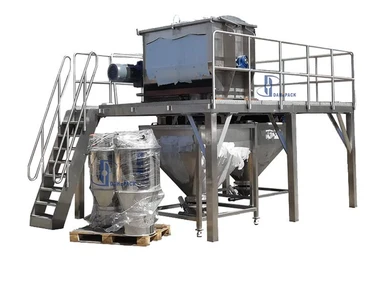
If you’ve ever walked through a production facility handling dry powders, granules, or custom blended mixes, chances are you’ve stood next to a ribbon blender or paddle blender—two workhorses that keep material consistency, batch uniformity, and production timelines on track. As a supplier of these mixers, I talk to maintenance teams, plant managers, and equipment operators every week who ask the same question: “How do I lubricate the moving parts of my ribbon and paddle blenders to keep them running longer without unplanned downtime?” It’s not a trivial question. Skipping or rushing lubrication is one of the top causes of premature bearing failure, worn drive components, and inconsistent mixing quality—and no one wants a $10,000 batch of pharmaceutical powder or food grade granules ruined because a paddle blender seized mid-cycle. Over the past 12 years in this business, I’ve worked with over 200 production facilities across food, chemical, and cosmetic sectors to refine lubrication routines that balance efficiency, compliance, and equipment longevity. Today, I’m breaking down exactly how to lubricate these two common blenders, tailored to their unique moving parts, no guesswork required. Ribbon Blender And Paddle Blender

First, let’s clear up a quick note: ribbon and paddle blenders have similar core systems but distinct differences in their moving assemblies, so their lubrication routines aren’t one-size-fits-all. A ribbon blender uses a long helical ribbon (outer and inner, usually) that wraps around a horizontal U-shaped trough, spinning at a moderate speed to fold and move materials. Its key moving parts are the drive motor, gearbox, output shaft, two end bearings, and the ribbon shaft itself. A paddle blender, meanwhile, has shorter, flat or angled paddles attached to a horizontal shaft, often running at a slightly higher speed, and many models have an optional liquid spray bar or discharge gate that adds a few extra lubrication points. That small difference in shaft design changes how you approach lubrication, so we’ll split this guide into two sections, plus a few critical best practices that apply to both.
Let’s start with ribbon blenders, since they’re the more common model for large, high-volume mixing. The most important moving parts here are the shaft bearings at each end of the trough, and the gearbox that powers the ribbon. I can’t stress enough how many operators I’ve met who skip bearing lubrication because they “don’t make noise”—but silent wear is real. For standard industrial ribbon blenders (rated for food or general chemical use), we recommend using a lithium complex grease with an NLGI (National Lubricating Grease Institute) grade of 2 or 3. Lithium complex works because it has a high dropping point—usually 350°F or higher—so it won’t break down under the consistent heat generated by a continuously running gearbox. If your blender is rated for food contact (which most of our clients in baked goods, supplements, and pet food use), switch to a food-grade lithium grease, one that meets NSF H1 certification. That means it’s safe for incidental food contact, which is a regulatory requirement for industries like pharmaceuticals and confectionery—using the wrong grease can force a full equipment shutdown and batch recall, something no plant wants.
Now, how often do you lubricate the ribbon blender’s bearings? That depends on your operating hours. If you run your blender 24/7 for mass production, lubricate the bearings every 500 operating hours. For facilities that run on two 8-hour shifts, five days a week, every 1,000 hours works. A simple way to track this: every time you do a batch change, jot down the run time on your blender’s control panel. When that number hits 500, schedule a quick lubrication stop. When you do lubricate, don’t overdo it—common mistake number one. Over-greasing bearings traps heat and moisture, which causes wear faster than under-greasing. Follow the grease fitting’s recommendation: most standard bearings take between 10 and 15 grams of grease per point. I always tell our clients to pump the grease gun until they see a small amount of fresh grease seep out from the bearing seal—that’s your sign you’ve added enough, no more. For the gearbox, you’re not using grease here—you’re using gear oil. Most ribbon blenders come from the factory with a specific viscosity: for low-speed ribbon shafts, that’s usually ISO 220 or ISO 320 gear oil. Check the dipstick on the gearbox every month; if the oil level is below the minimum mark, top it off with the same brand and viscosity to avoid foaming or friction. Change the gear oil completely every 2,000 operating hours, or every six months, whichever comes first. Contaminated gear oil is another hidden issue: metal shavings from worn gears mix with old oil, and that’s what ends up destroying the entire drive system.
Now, paddle blenders. Paddle blenders are often used for smaller batches, higher-speed mixing, or applications that require more aggressive material movement—think seed coatings, fertilizer blends, or powdered cleaning agents. Their moving parts are a bit more exposed, which means they attract more dust and debris, so your lubrication routine needs to account for that extra contamination risk. The key parts here are again the end shaft bearings, but many paddle blenders also have lubrication points for side drive chains, especially if they’re heavy-duty models for 24/7 operation, and sometimes bearings for optional discharge gates or spray bar pumps.
For paddle blender bearings, the same base rule applies, but I adjust the grease grade slightly. Because paddle blenders often run at higher speeds, they need a grease that can handle rotational stress without thinning out. A lithium complex grease with NLGI grade 2 is ideal here—thicker than the grease for ribbon blenders, it stays in place better at higher speeds. For food-grade paddle blenders, stick to NSF H1 rated grease, same as with ribbon blenders. The lubrication interval is a bit more frequent too, because those higher speeds generate more heat, and more exposure to process dust accelerates grease breakdown. If you run your paddle blender around the clock, lubricate the bearings every 300 operating hours. For 8-hour shifts, every 700 hours. Again, avoid over-greasing—too much grease on paddle shaft bearings will attract more dust, which mixes into the grease and acts like sandpaper inside the bearing. For side drive chains, if your paddle blender has them, use a light-weight gear oil, ISO 100 or ISO 150, applied with a brush or spray bottle every two weeks, or after every 50 hours of operation. Chains need to be lubricated when they’re cool, not right after a run when they’re hot—hot oil will drip off instead of coating the links properly. And for discharge gates or auxiliary bearings in paddle blenders, lubricate those every time you lubricate the main shaft bearings, since they’re often exposed to residual material that can cause friction.
Wait a second—before you grab that grease gun, there are a few universal rules for both blenders that I wish every operator knew. First, clean the grease fitting before you add any grease. It’s a tiny opening, and dust or old grease can block it. If you force grease into a blocked fitting, you’ll end up pushing contaminants into the bearing, which is a one-way ticket to bearing failure. I keep a can of compressed air and a small wire brush near every blender to clear the fitting before lubrication—takes 10 seconds, saves thousands in repairs. Second, always use the same type of grease or oil, never mix brands or viscosities. Greases from different manufacturers have different additives that can react with each other, turning from a smooth lubricant into a thick, gummy mess that does more harm than good. If you switch grease brands, flush the bearing completely first—don’t just top it off. Third, if you notice any red flags during lubrication, address them right away. If the grease you pull out of a bearing is discolored, full of metal shavings, or has a gritty texture, that’s a sign of wear. If a grease fitting is bent or broken, replace it immediately before it seizes up and you have to disassemble the entire shaft to lubricate. And if your blender is making loud, groaning noises while running, that’s not normal—check your lubrication level before you schedule a full tear-down.
I’ve seen too many facilities cut corners here. Last year, I worked with a pet food manufacturer who skipped lubricating their ribbon blender’s bearings for 18 months because their maintenance team was short-staffed. The bearing seized mid-batch of chicken meal and rice blend, which meant the entire batch had to be discarded, and they had to order a new bearing assembly that cost $8,000, plus 3 days of downtime that delayed their delivery to Walmart. A 15-minute lubrication every 500 hours would have prevented all that. On the flip side, I’ve seen clients follow the routine exactly and get 15+ years out of their blenders, when the average lifespan of a well-maintained ribbon or paddle blender is 10 to 12 years.
For facilities that handle very fine, dusty materials like titanium dioxide or silica, add one extra step to both blenders: install grease fitting covers. Those little plastic caps keep dust out of the fitting between lubrication stops, so you don’t end up pumping dirt into your bearings. It’s a $2 fix per fitting that saves hundreds in repairs.
At the end of the day, lubrication isn’t a one-time task—it’s a routine that keeps your mixers running smoothly, keeps your product consistent, and saves you from unplanned downtime. I always tell our clients that a good lubrication schedule is the cheapest maintenance investment you can make for your blenders. If you’re not sure about your specific model’s lubrication points, or you need a custom schedule tailored to your operating hours and material type, our team is here to help. We’ve worked with production teams in every industry, from small craft bakeries to large chemical processing plants, to build maintenance plans that fit their needs. Whether you’re looking to upgrade your current mixers, or you have questions about keeping your existing equipment running, reach out to our team to talk through your needs. We’re not just a blender supplier—we’re partners in keeping your production line moving.
screw feeder and vacuum feeder If you need additional resources to reference these guidelines, industry standards for lubrication of process equipment and mixer maintenance best practices are outlined in the following sources:
- National Lubricating Grease Institute (NLGI) Lubrication of Process Equipment Guidelines
- Food and Drug Administration (FDA) Guidelines for Food-Grade Lubricants in Food Manufacturing Equipment
- American Society of Mechanical Engineers (ASME) Maintenance Practices for Industrial Mixers
Shanghai Dahe Packaging Machinery Co., Ltd.
Shanghai Dahe Packaging Machinery Co., Ltd. is one of the most professional ribbon blender and paddle blender manufacturers and suppliers in China, featured by quality products and competitive price. Please rest assured to buy high-grade ribbon blender and paddle blender for sale here from our factory.
Address: 1098#, Minta Road, Songjiang District, Shanghai, 201617, China.
E-mail: International@dahepack.com
WebSite: https://www.dahe-powderfillingmachines.com/
